Skip to the content



Generative AI in banking refers to large language model based capabilities that can create, summarise, classify, and transform content, then take guided actions across workflows.
In practice, banks are using Generative AI-driven tools to speed up document-heavy work, improve service quality, and support employees with faster access to approved knowledge. You will see this across investment banking (research summarisation, pitchbook drafting, deal documentation support) and commercial banking (relationship manager copilots, credit and onboarding documentation, service operations).
Recent industry reporting shows major banks accelerating GenAI rollouts through partnerships and internal assistants, with a strong focus on governance and controlled deployment.
Why Is Generative AI in Banking Important?
Banks operate in a high-trust, high-regulation environment, and much of the work is information-intensive: policies, contracts, customer communications, credit documents, controls evidence, and case notes. Generative AI matters because it can compress that effort without sacrificing quality, as long as it is deployed with the right boundaries.
It also helps banks respond to pressure from three sides at once: customers expect faster, clearer service; teams face rising operational load; regulators and risk functions require consistency, traceability, and accountability. UK regulators have documented widespread AI use across financial services, alongside the need for stronger controls as adoption grows.
How to Build a Generative AI Operating Model in Banking
Most banks that scale GenAI successfully converge on an operating model that balances speed with control. The exact org design varies, but the core components are consistent.
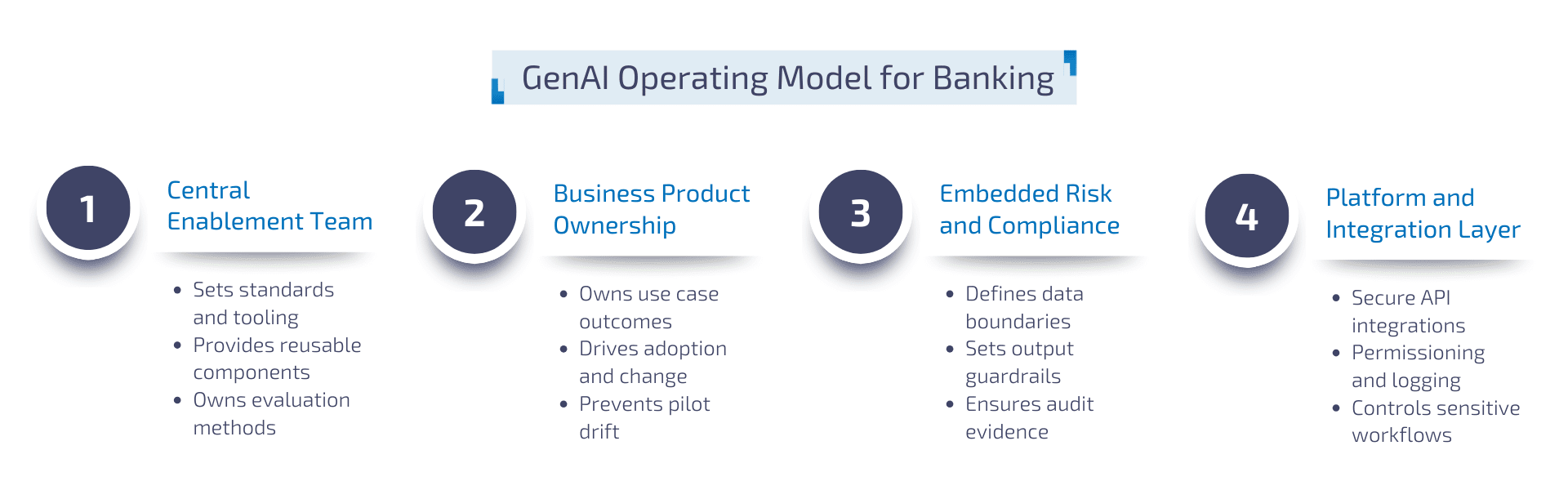
A central enablement team sets standards: This group typically owns reference architectures, model onboarding, security patterns, prompt and policy standards, evaluation methods, and the approved tooling stack. They also provide reusable components such as retrieval pipelines, redaction, and logging.
Business-led product owners drive use cases: Each use case needs a named owner in the business, accountable for outcomes, user experience, and ongoing change management. Without this, pilots stall or drift.
Risk, compliance, and model governance are embedded: Rather than acting as a final gate, risk and compliance should shape requirements early: what data can be used, what outputs are allowed, when human review is required, and what evidence must be logged. MAS has published good practices for AI and GenAI model risk management that emphasise governance, validation, and continuous monitoring.
Platform engineering enables safe integration: GenAI becomes valuable when it connects to real systems, securely. A strong operating model includes API integration patterns, permissioning, audit logs, and controls for sensitive workflows.
Generative AI in Banking Use Cases
Generative AI in banking delivers the most value when it is applied to high-volume, knowledge-heavy workflows where outputs can be grounded in approved sources and routed through clear approval steps.
Employee copilots for knowledge and policy.
A common early win is an internal assistant that helps staff navigate policies, procedures, product details, and operational playbooks. Instead of searching across multiple repositories, employees can ask questions and receive answers grounded in approved sources, with references and escalation paths when confidence is low.
Customer service augmentation, not just chat.
GenAI can support agents by summarising conversations, drafting responses in approved language, suggesting next best actions, and generating case notes. For customers, it can power guided self-service for low-risk journeys, while keeping strict guardrails for anything sensitive, regulated, or account-changing.
Credit and lending workflows
In commercial banking especially, credit processes involve heavy documentation and repeated analysis. GenAI can help extract and summarise borrower information, draft internal memos, highlight missing documentation, and support credit review packs. The key is controlled generation with clear human accountability and strong evidence trails.
Onboarding and KYC support
Banks can use GenAI to streamline onboarding by guiding customers or relationship teams through documentation requirements, drafting communications, and summarising submitted materials. It can also assist compliance teams by organising KYC narratives and assembling evidence packs, while leaving decisions to authorised humans.
Investment banking productivity
In investment banking, GenAI is often applied to summarising research, drafting first versions of pitch materials, producing meeting briefs, and turning unstructured notes into structured outputs. These use cases benefit from clear templates, approval workflows, and strict controls on data sources.
Risk, compliance, and controls support
GenAI can help teams draft policy content, summarise regulatory updates, create control narratives, and prepare audit-ready documentation. It can also support investigation workflows by structuring case information and highlighting inconsistencies, while keeping the final judgement with accountable owners.
IT and operations assistants
Across ITSM and operations, GenAI can summarise incidents, generate change documentation, propose runbook steps, and improve knowledge article quality. This is often a practical path to value because the workflows are well-defined and the operational data is already structured.
Generative AI in Banking – 5 Benefits
When deployed with strong governance and secure integration, generative AI improves speed, consistency, and productivity across banking operations while keeping risk and compliance under control.
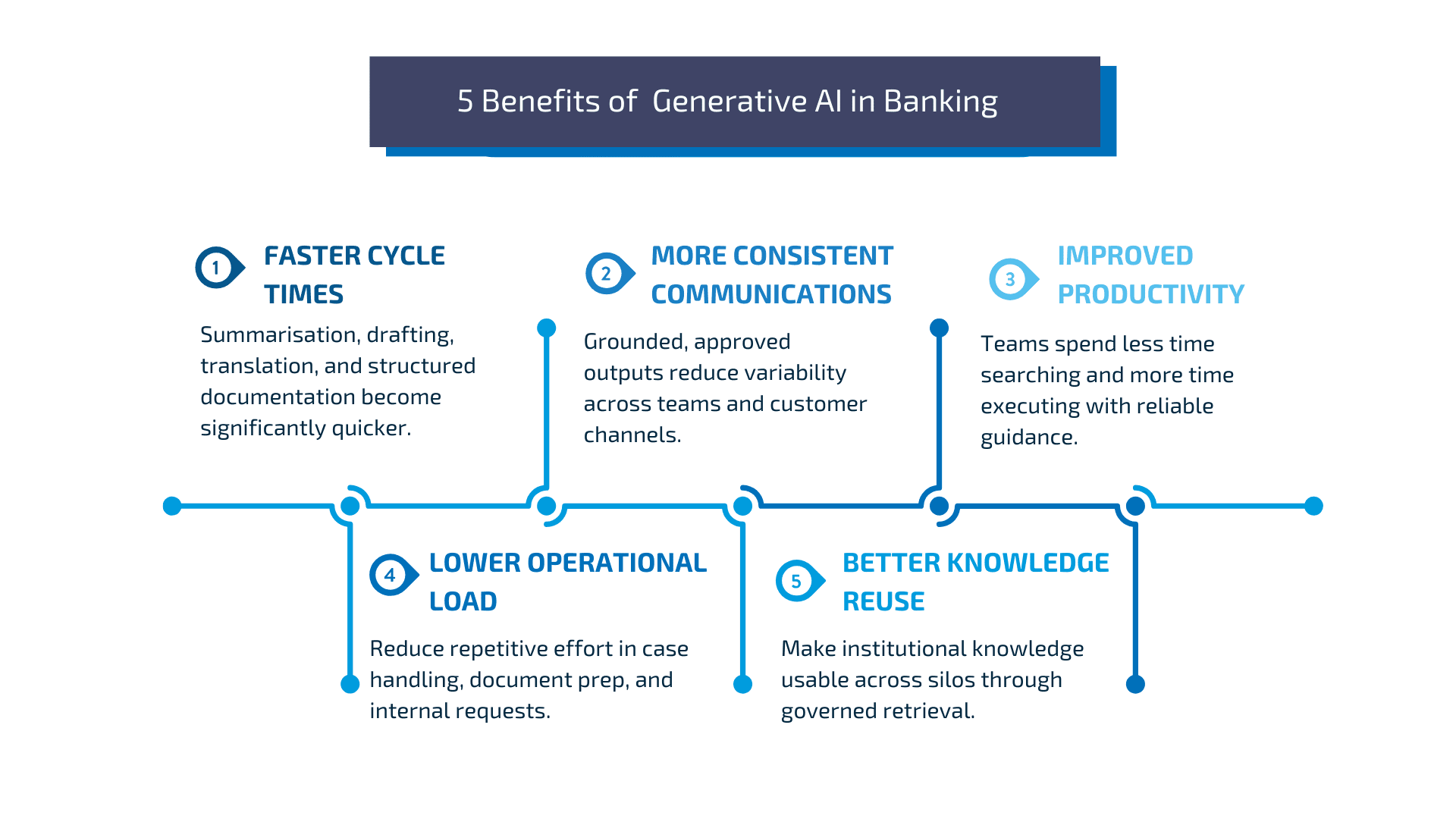
1. Faster cycle times for information work
Summarisation, drafting, translation, and structured documentation become significantly quicker, which matters in banking where throughput is limited by review capacity.
2. Higher consistency in customer and internal communications
When grounded in approved knowledge and governed templates, GenAI can standardise language and reduce variability across teams and channels.
3. Improved employee productivity and onboarding
New joiners and frontline teams spend less time searching and more time executing, especially when the assistant can answer “how do we do this here?” questions reliably.
4. Lower operational load in service and back office
GenAI can reduce repetitive effort in case handling, document preparation, and internal requests, allowing capacity to shift to exceptions and higher-value work.
5. Better reuse of institutional knowledge
Banks often have knowledge trapped across documents and silos. A governed retrieval layer makes that knowledge usable, while preserving control.
Generative AI in Banking Challenges
Scaling generative AI in banking brings specific challenges around accuracy, data protection, auditability, integration, and accountability, which must be designed for upfront rather than managed after launch.
Hallucinations and ungrounded outputs
The biggest risk is confident but incorrect content. The mitigation is not “better prompts” alone. Banks need grounded generation (often via retrieval), strict response boundaries, and clear escalation triggers.
Data privacy, leakage, and access control
GenAI must respect least-privilege access. Sensitive data requires redaction, secure handling, and strong separation between public information and authenticated journeys.
Model risk management and auditability
Traditional validation approaches are not enough on their own. Banks need ongoing monitoring, defined acceptance thresholds, and evidence trails that show what the model saw and why it produced an output.
Integration complexity
Many pilots fail because they deliver “nice answers” without action. Real value comes when GenAI is connected to workflows and systems through secure APIs, with approval steps where required.
Over-reliance and accountability drift
Employees can over-trust generated content. Successful deployments set clear accountability rules, require human review for defined classes of outputs, and train users on when not to rely on the tool.
Regulatory expectations evolving quickly
Banks must design for changing guidance. A flexible governance model, strong documentation, and traceable controls reduce rework as expectations mature.
Unlock Generative AI in Banking with BGTS
If you are exploring generative AI, or looking to integrate AI more deeply into your existing systems, BGTS can help you shape the roadmap, implement the right architecture, and deliver measurable outcomes across service, cost, and customer experience.